
Background
Since joining the company, I’ve sat through a few sessions of Grow with Google, the 10X Innovation Culture Program. They were mostly watching videos plus a bit of brainstorming, and I never felt like I got anything concrete I could actually apply. Honestly, it felt like a pure waste of dev time.
I figured it would probably just fizzle out like that. But just as I was thinking that, HR came through in a big way: they brought in actual Googlers to answer our questions in person, and told us to prepare questions in advance.
Now, I’m not exactly bursting with deep insight, and I couldn’t come up with any good questions myself (asking good questions is a skill in its own right). So I’ll spare you my embarrassing attempts and just share the notes I took from other people’s questions.
Attendees
- Kota Akiyama (Kota) - Senior Account Executive, and the host of this session
- Emiko Ikeda (Emiko) - Director, Global Strategic Programs
- Miho Suzuki (Miho) - Account Manager, Large Customer Sales
- Haruka Matsushita (Haruka) - Regional Manager, SMB
- Mayuko Ozawa (Mayu) - Partner Development Manager
- Sawako Shirahama (Sawako) - Senior Account Executive
“Don’t Micromanage”
● Could you share the specifics of how often, and in what ways, progress information is shared between managers and their team members?
● I feel some members tend to slack off when they’re given a lot of freedom or very little supervision. Does that happen at Google? If not, what do you think the reason is?
In a nutshell, Google’s management philosophy is:
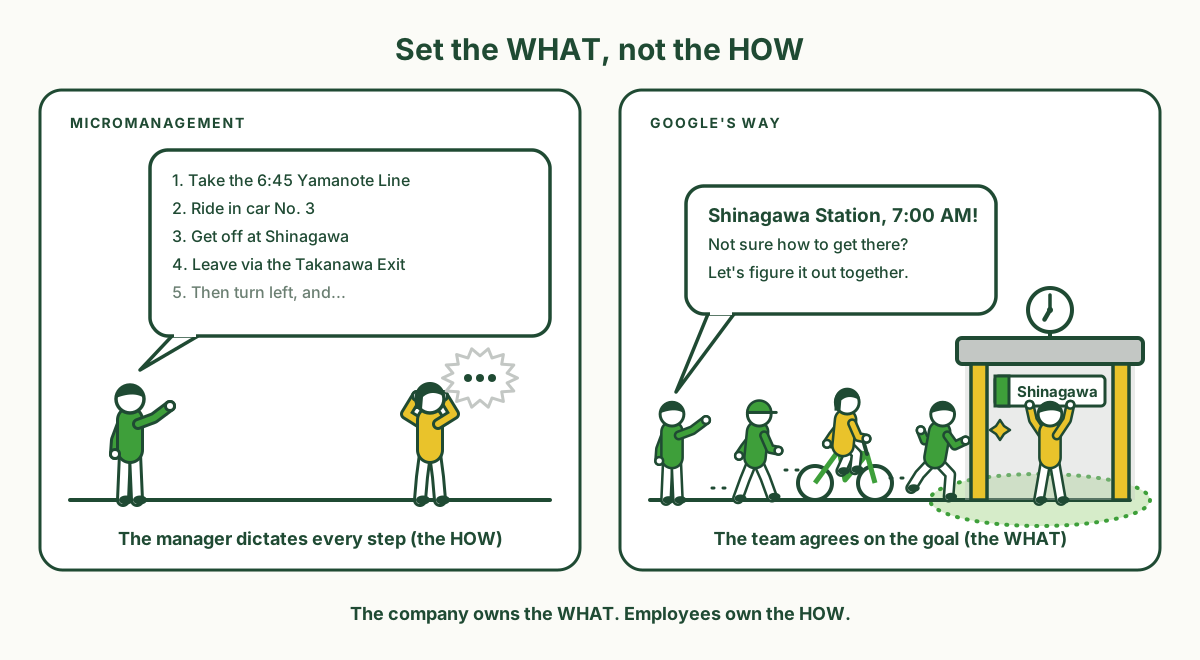
The company only decides the “WHAT,” and leaves the “HOW” up to employees.
The “getting to Shinagawa Station” example they gave explains this well:
-
Traditional, micromanaged style: “Take the 6:45 AM Yamanote Line, get in the third car, get off at Shinagawa Station, leave through the Takanawa Exit…” That’s dictating every single step of the employee’s actions (the HOW).
-
Google’s way: “We meet at Shinagawa Station at 7 AM” (that’s the goal, the WHAT). “If you don’t know how to get there, we can figure it out together” (that’s offering support, not giving orders).
Q: How often, and how, do managers and members share progress?
-
The core of the answer: the focus is on progress toward goals, not the details of the process.
-
Example: A manager won’t ask you every day “how many lines of code did you write today?” Instead, in a weekly meeting or a 1-on-1, they’ll ask “how far are we from this quarter’s goal?” or “are there any blockers I can help clear?” The cadence might be once a week (like a 1-on-1 meeting), but the conversation is about high-level obstacles and direction, not about monitoring your actual work.
Q: With so much freedom, don’t employees slack off? Why doesn’t that happen at Google?
-
The core of the answer: it comes down to two things: hiring and culture.
- Hiring: From day one, Google works hard to hire people who are self-driven and passionate about solving problems. They trust that the people they bring in want to do good work and can be trusted.
- Culture:
- Trust is motivating: when the company trusts you and treats you like an adult who can solve problems on your own, you naturally pay that trust back through your actions.
- Transparent goals (OKRs): everyone’s Objectives and Key Results are open and transparent. You know exactly what your work contributes to the team and the company. That sense of meaning and impact is a powerful motivator all by itself.
- Improvement plans
- The answer wasn’t airtight, either. They did reveal that Google has something along the lines of a performance improvement plan. If you land in it and still don’t improve, well… everyone knows what happens next.
OKR (Objectives and Key Results)
● In a culture that pursues huge “10X” innovation, how does Google run its management?
Q: How does the company’s grand vision align with each small team’s goals?
-
Answer: through OKR “cascading.”
-
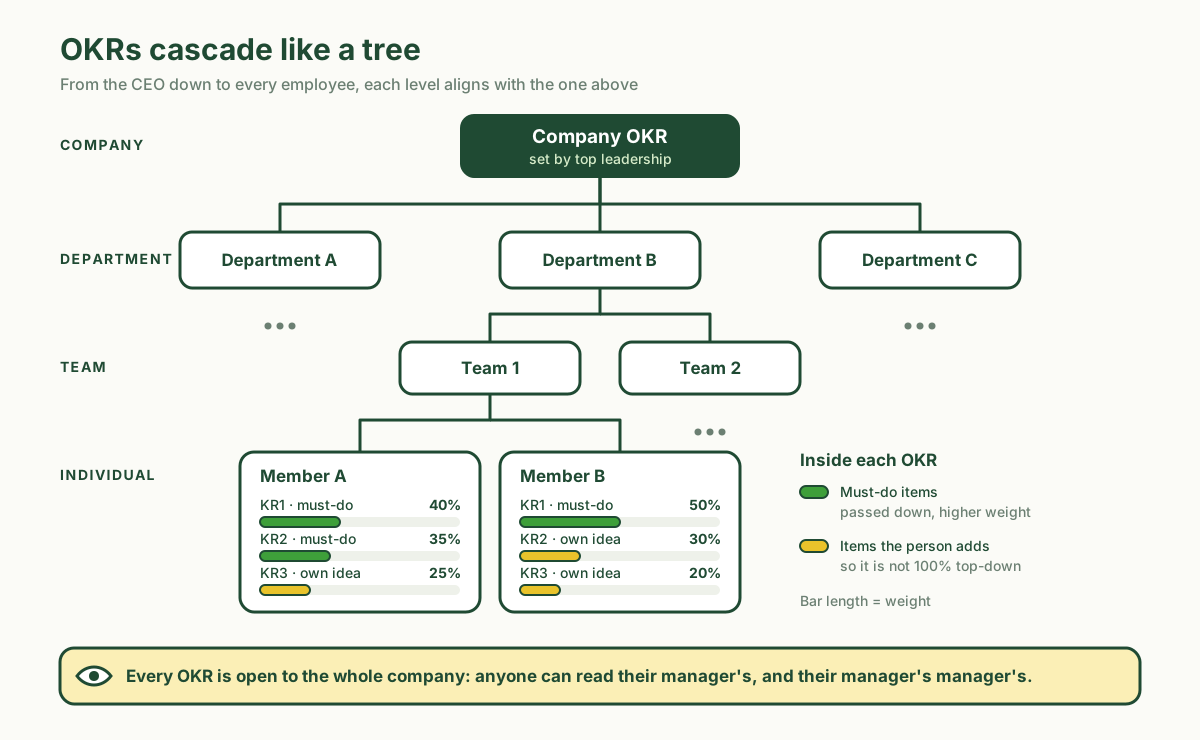
In short: the top of the company sets company-wide OKRs, and every department, every team, and even every individual employee aligns their OKRs to them. It’s like a giant tree diagram running from the CEO all the way down to each employee.
-
Key points (memo):
-
The process isn’t 100% top-down orders. Employees also have leeway to work things they personally want to do into their own OKRs.
-
That said, the company does have some “must-do items” (マスト項目), which carry a higher weight (ウェイト) inside the OKRs.
-
Q: Employees have a lot of freedom (like the 20% time for personal projects). How do managers track project progress?
-
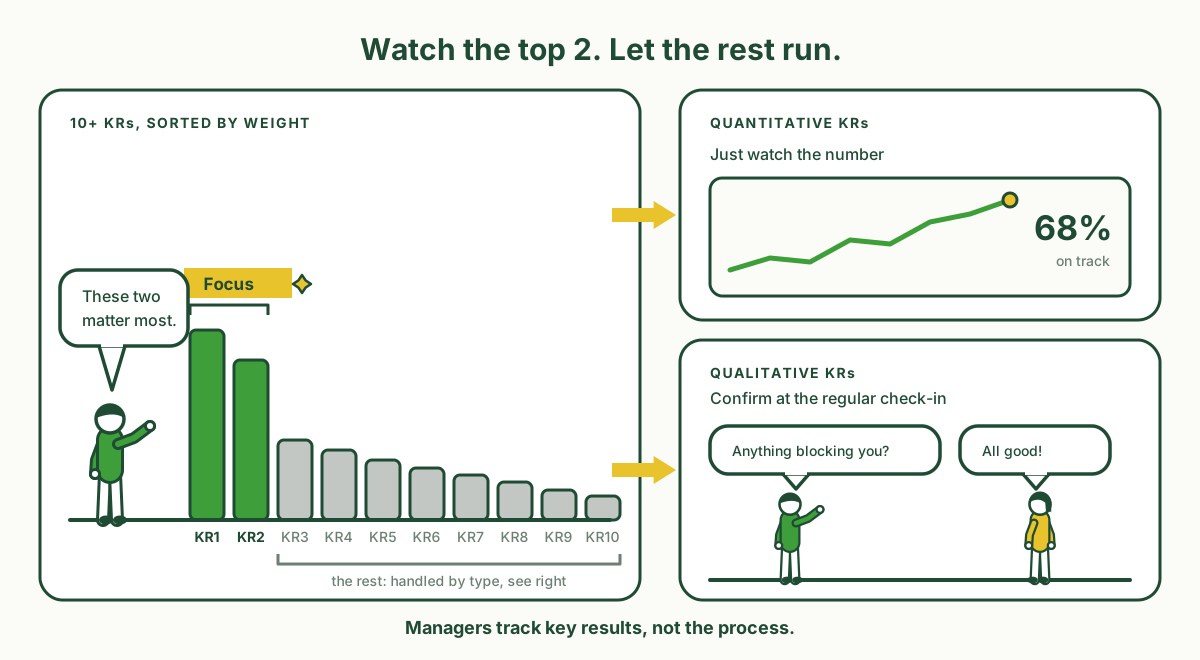
Answer: again, through OKRs. Managers don’t track the “process.” They only track progress on the Key Results (KRs).
-
Concrete examples (memo):
-
Kota’s approach: He might have a lot of KRs (10 or more), but he focuses on the top 2 (the highest-weighted ones). For the rest, if a KR is quantifiable, he just tracks the numbers; if it’s qualitative (hard to measure), he confirms things are fine during the regular check-ins/reviews.
-
Sawako’s approach: Many of her KRs are tied to customer needs. In other words, her goal is “make the customer successful,” and whether she hits her KRs depends on the customer’s situation. That keeps her work tightly connected to external value.
-
Q: Does Google have any unique rules around evaluation and meetings?
-
Fairness in evaluation: Since not every KR needs to be 100% complete, how do you evaluate performance? To avoid a situation where one department’s manager grades leniently and another’s grades strictly, the managers hold regular meetings to “calibrate” and align their evaluation standards (MGR 同士の横の部門とも擦り合わせ), which keeps things fair.
-
Meeting rules: They didn’t state a rule outright, but from Kota’s example you can tell that meetings (like check-ins/reviews) are centered on communicating around the OKRs (checking progress and removing blockers) rather than grilling people on the details of their work.
Bottom-Up Feedback
● I’d like to know how (at Google) reports evaluate their managers, and how that system was set up. ● When setting department goals, what level of granularity should be used?
Q: How do reports evaluate their managers? How was the system built?
-
Answer: Google has a formal, once-a-year process for employees to evaluate their managers.
-
Details (memo):
-
Scoring: reports rate their manager on a 5-point scale, covering things like “are your instructions aligned with company strategy?” and “are you approachable and easy to communicate with?”
-
Free-form comments: there’s also an open text box for specific suggestions, like “if you did X, my output would be higher.”
-
A higher-level view: beyond direct feedback from reports, a manager is also evaluated on their impact (インパクト) from a third-party perspective: how much their work contributes inside and outside the department, even at the country or global level, and whether it pushes the company’s core strategy forward.
-
Q: How are department goals set? What framework and format?
-
Answer: the OKR framework, with a standardized format.
-
Details (memo):
-
Format: there’s a standard template: usually one big “category” followed by the specific Key Results under it.
-
The key is openness (オープンになっている!大事!!): this is the most important piece of culture. Everyone’s OKRs, including every single manager’s, are visible to the whole company. You can look up your boss’s OKRs, or even your boss’s boss’s, anytime. That’s how they make sure everyone is pulling in the same direction.
-
How to Encourage Free Expression
How do you get a new culture to actually permeate a team? And how do you encourage free creative expression?
The Googlers’ advice was consistent: don’t push it top-down. Nurture it bottom-up.
Q: What should a team leader do so a new culture sinks into the team?
-
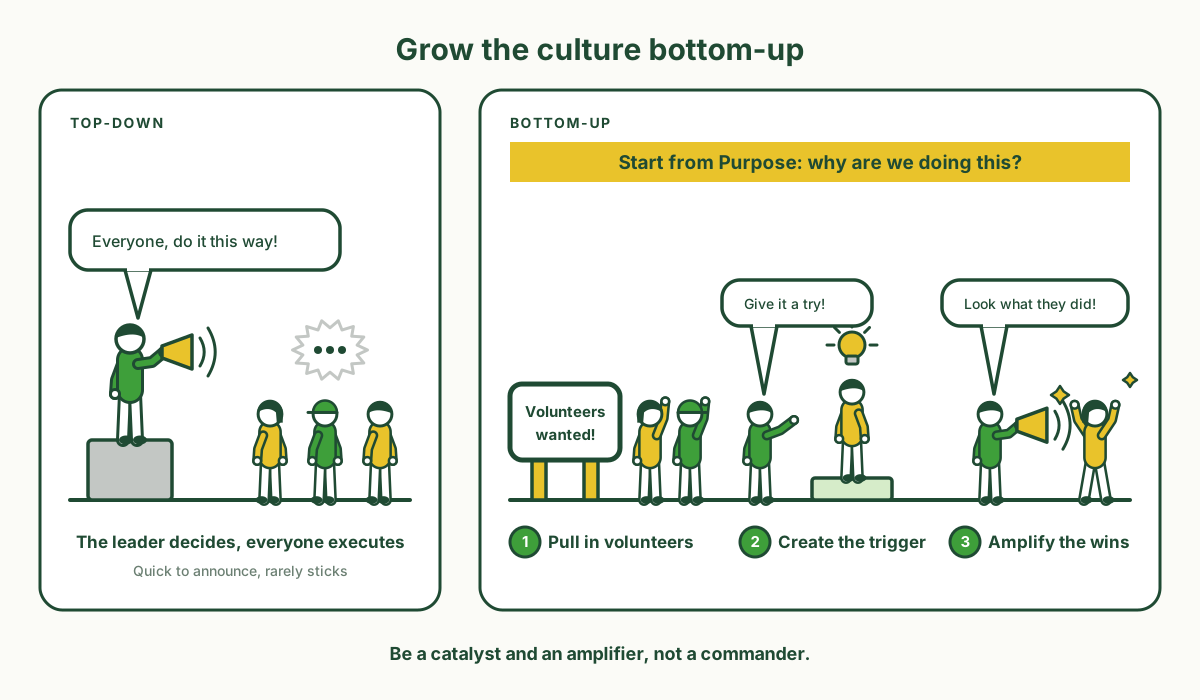
Answer: the leader’s role isn’t “commander.” It’s “catalyst” and “amplifier.”
-
Pitfall to avoid: the discussion pointed out that the easiest mistake is running it “central-government style” (中央集権的にやりがち): the leader decides everything alone and tells everyone to just execute. Google’s advice is to do the opposite.
-
Details (memo):
-
Pull in volunteers (ボランティアの巻き込み): rather than the leader promoting the culture, openly recruit interested “volunteers” and get people from different backgrounds involved. That creates a feeling of “we built this culture together” (みんなで作った), which boosts the momentum enormously.
-
Create the trigger (キッカケを作る): every team has people with ideas who don’t quite dare to act on them. Your job is to create an opportunity, a safe space, so they can take that first step.
-
Amplify the wins (やった事を広めてあげる): when the volunteers produce good results that fit the new culture, the leader’s key job is to publicize and celebrate it so more people see it. It’s “backing things that sprang up on their own” (自然発生的に出来たものを後押ししたい).
-
-
Go back to “Purpose” before “culture” (カルチャーのよりも Purpose)
-
“Build a company culture” can ring pretty hollow as a slogan.
-
The advice here: before doing any culture-building, go back to the most fundamental question: “what is this for (Purpose)?”
-
Tie it to the company’s fundamental goals and reason for existing. That way, culture-building stops being an empty slogan and becomes concrete action toward the company’s mission, and it resonates much more with everyone.
-
Q: In what mindset, motivation, and environment are people most willing to share ideas freely?
-
Answer: when the environment feels “safe,” “fun,” and “connected.”
-
Details (memo):
-
Mindset / motivation (マインド・モチベーション): the best starting point is “this sounds fun” (楽しそうだな). People contribute ideas most willingly when joining in feels fun rather than like a task.
-
Environment (環境):
-
Safety: the volunteer system itself creates safety, since it’s not a mandatory assignment, people aren’t afraid of failing.
-
Connection and collaboration (つながりとコラボレーション): actively create opportunities for people from different backgrounds to get to know each other and work together. When people know and trust each other, they’re more willing to say what they really think.
-
-
Breaking the “you suggested it, you own it” curse (言い出しっぺが全部やることにならないように)
-
This is a crucial detail. A lot of people won’t voice new ideas because they fear that “once I say it, I’ll have to carry the whole thing myself from start to finish.”
-
The advice from the discussion: leaders and organizations should consciously break this unwritten rule. Make it explicit: proposing a good idea is already a contribution to the team, and everyone can work together to make it real, it isn’t an extra burden dumped on the person who suggested it. That’s what gets more people to open their mouths.
-
-
TGIF (Thank God It’s Friday)
How does Google use the TGIF all-hands meeting to promote open communication?
Q: What kinds of questions get discussed at TGIF?
-
Answer: anything can come up, and the range is wide.
-
Details (memo):
-
Topics are all over the place (テーマはバラバラ): from company strategy to sensitive topics (the “ここまで話すの?”, “wait, we can say that out loud?” kind).
-
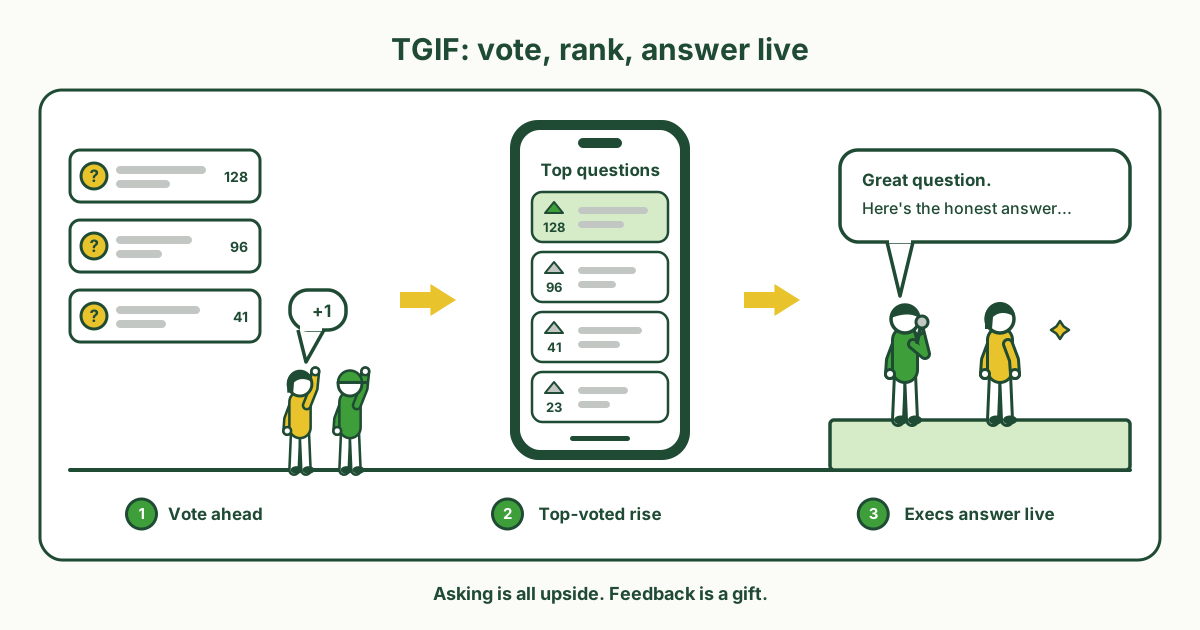
Voting + live answers: employees can vote ahead of time on the questions they want asked, and the executives answer the top-voted ones off the cuff, live (アドリブで答えていく).
-
Q: Why do Google employees dare to ask questions, instead of staying silent like in Japanese companies?
-
Answer: it comes from a core mindset and the company culture.
-
Mindset (マインド): employees feel that “asking is all upside; not asking is your own loss” (聞いてナンボ、聞かないと損をする). They don’t worry that their question is “out of place” (場違いとかそんなのない).
-
Culture (文化):
-
Psychological safety (心理的安全性): this is the key. The company has a culture of “affirming the act of asking itself.” No matter what you ask, you won’t be criticized or shot down.
-
“Feedback is a gift”: this idea runs deep. Everyone believes that raising questions and giving feedback is itself a valuable contribution to the company.
-
A shared atmosphere: it’s not just brave questioners. The hosts and executives also work hard to create an atmosphere where people feel safe asking.
-
Q: What do senior leaders announce at TGIF?
-
Answer: the main content is answering the questions employees care about most.
-
It’s not a one-way broadcast. They communicate two-way with the whole company by answering the questions employees voted up.
 Hi, I’m CheerChen.